Storm Restoration Playbook: How to Canvass, Measure, and Quote 50 Roofs in 48 Hours After a Hailstorm
Reviewed by roofing measurement engineers · References NBC 2020, IRC 2021, FBC 8th Ed. · Roof Manager is the roof measurement & CRM platform trusted by 5,000+ contractors across the US & Canada · Editorial policy.
TL;DR
The first 48 hours after a hailstorm decide who wins the deployment. Here's the hour-by-hour playbook — inbound handling, canvassing, remote measurement, and full-envelope contracting — that lets a single-crew operation sign 50 roofs before competitors have returned their first voicemail.
Quick Answer: The first 48 hours after a qualifying hailstorm decide which roofing contractors win the deployment. To sign 50 full-envelope storm contracts in that window, a contractor needs four things working simultaneously: a lead-capture form and CRM absorbing the 300–500 inbound enquiries, an instant satellite measurement pipeline that produces insurance-ready reports in 1–2 hours, a structured canvassing script and territory map, and a CRM that auto-generates contingency agreements with e-signature. The operations that execute this play consistently capture 5–10x the revenue of competitors running 2019-era phone-and-clipboard workflows.
Storms are the entire year's revenue for a lot of roofing operations. A single qualifying hail event across a suburban metro can represent $5M–$30M in accessible work within a 48-hour window. The operations that consistently capture that revenue aren't the ones with the biggest ad spend, the prettiest trucks, or the longest history in market — they're the ones with the tightest execution in the first two days.
This post is the hour-by-hour playbook. It assumes you already run a roofing company, already understand the insurance claim process, and already know what a contingency agreement is. What it adds is the modern software stack and the sequencing that lets a small-to-mid operation act like a large one during the window that matters.
The 72-Hour Window: Why Speed Dictates Storm Revenue
Three compounding dynamics make the first 48–72 hours after a qualifying storm disproportionately valuable:
Homeowner attention is at its peak. The yard is full of shingle debris, the ceiling is stained, the neighbors are talking. A homeowner who is still in active problem-solving mode is 3–5x more likely to sign a contingency agreement than the same homeowner three weeks later once the anxiety has faded.
First-mover wins at ~85%. Multiple independent home-services studies converge on the finding that the first contractor to engage a storm-damaged homeowner wins the contract roughly 85% of the time. Reviews, pricing, and brand presence only matter when two contractors are competing — and in the first 48 hours, most homeowners are only talking to whoever reached them first.
Insurance timelines are forcing functions. Most policies require claim submission within 12 months of the loss event, but adjuster availability, inspection scheduling, and carrier backlog all deteriorate fast as the deployment matures. Contracts signed in the first 48 hours get claim inspections within 5–10 days; contracts signed at week three often wait 30+ days for an adjuster, and by then the homeowner's motivation has decayed.
The operational implication is that every hour of delay inside the 48-hour window costs revenue at a non-linear rate. The target isn't "work hard during storm weeks" — it's "execute a specific play that compresses days of work into hours."
Hour 0–6: Automating Inbound — Handling 300% Call Spikes
The storm passes. Phones start ringing. What happens in the next six hours decides whether the operation captures its share of the deployment or watches it bleed to competitors.
The failure mode
A traditional operation with one office phone, two lines, and one or two human dispatchers hits capacity at roughly 8–12 concurrent calls. At typical storm surge levels (300–500% above baseline), inbound call volume easily exceeds 40–80 calls per hour during the peak. The math is unforgiving: any call that doesn't get answered within the first 3–5 rings is lost to the next contractor on the homeowner's Google search results.
Voicemail does not save the call. Industry data on missed-call callback conversions during storm events is brutal — callback close rates drop to 10–15% versus 35–50% on live-answered calls. By the time the office manager returns the voicemail, the homeowner has already signed with someone else.
What the play looks like in 2026
instant estimator handles 100% of inbound volume. A modern real-time voice agent answers every call in under 500ms, qualifies the lead conversationally, detects emergency language, books the inspection directly into the crew calendar, and writes the full transcript into the CRM. The system scales to effectively unlimited concurrent calls because each conversation runs on its own inference instance. A 200-call-per-hour surge is handled identically to a quiet Tuesday.
During storm deployments, the revenue per recovered call jumps from $3,000 baseline to $12,000–$45,000 storm-restoration blended averages.
Emergency escalation routes live. The AI is configured to detect keywords like "water coming through the ceiling," "tree on the house," "tarp needed tonight" and route those calls live to an on-call sales manager or crew lead with a simultaneous SMS to the on-call phone. Emergency-tarp response wins permanent replacement contracts at 60–80% close rates because the homeowner has already been served once.
CRM auto-routing by ZIP code. As leads are captured, the CRM automatically assigns them to the nearest available crew and inspection slot based on GPS and current schedule density. Dispatchers manage exceptions, not every call.
The six-hour target
By hour six, an operation with this stack has 60–150 qualified leads in the CRM, each with a confirmed inspection time in the next 48 hours, each with measurement data already pulled from satellite for the sales rep to review before the site visit. Operations without this stack have 80% of that same demand sitting in a voicemail queue that won't be worked through until Monday.
Hour 6–24: The No-Climb Measurement Strategy
While the phones are still ringing, the measurement pipeline is running in parallel. This is where the second major acceleration happens.
The old workflow
Traditional storm-restoration operations dispatch a sales rep to every lead in person, the rep climbs or ladders the roof, sketches the measurements on graph paper, estimates pitch with a handheld gauge, and returns to the office to type the numbers into an estimate template. A good rep processes 6–10 inspections per day at this pace. At 8 inspections × 2 reps × 48 hours (minus sleep) = roughly 60–80 completed inspections. Then the office has to turn those sketches into written estimates, which takes another day.
The modern workflow
Sales rep arrives with the measurement already done. The rep's tablet loads the pre-pulled measurement, the suggested contract value, and the contingency agreement template before they knock on the door. Site visit time drops from 60–90 minutes (measure + walk + quote) to 20–30 minutes (walk-through + damage inspection + sign).
Drone verification scheduled automatically for signed jobs. On contracts above $15,000 or on complex geometries flagged by the measurement system, a drone verification is auto-scheduled for the following 48 hours. The drone pass captures close-range damage documentation for the insurance packet.
Daily throughput
With measurement pre-done, a single sales rep can execute 15–20 inspections per day during a deployment — roughly triple the throughput of a rep measuring manually. Two reps working a 48-hour window with good route planning complete 40–60 inspections, which is what enables the 50-roof target in this playbook.
Hour 24–48: On-Site Execution — From Door Knock to Digital Proposal
The window is now half over. Canvassing and structured contract execution carry the operation across the finish line.
The door-knock script for storm canvassing
Storm canvassing is a distinct sales discipline from retail roofing and should be treated as such. The fundamental script structure is consistent across high-performing operations:
- Identify the reason for contact. Reference the specific weather event, the specific damage you've seen in the neighborhood, and (if applicable) the specific addresses where you've already signed contracts. Specificity beats generic "storm damage" language by a factor of two in door-knock conversion studies.
- Offer the no-cost inspection. Frame it as an inspection, not a sales call. Homeowners respond to "free roof inspection" far more than to "free estimate" — the first implies expertise offered, the second implies sales pressure coming.
- Explain the insurance process if applicable. Many homeowners in first-storm markets don't understand that a qualifying hail claim costs them only the deductible. A brief explanation of the contingency process — roofer does the work, insurance pays the roofer directly, homeowner pays deductible — materially lifts sign rates.
- Book the inspection, not the contract. The goal of the door knock is a scheduled inspection, not an on-the-spot sale. Reps who try to close at the door convert at roughly half the rate of reps who book an inspection and come back to complete the full damage walk.
The contingency agreement
A storm contingency agreement — "this roofer will do the work, contingent on the insurance carrier approving the claim" — is the standard instrument of first-48-hour storm restoration. The agreement obligates the homeowner to work with this contractor if the claim is approved, but imposes no financial obligation if the claim is denied. Legal requirements for contingency agreements vary by state and province — Minnesota, Texas, and Colorado have specific statutes; most other jurisdictions treat them under general contract law.
What a modern contingency agreement workflow looks like:
- The agreement template is pre-loaded in the CRM with customer-specific fields auto-populated from the lead record (name, address, contract value pulled from the satellite-derived estimate).
- The sales rep reviews the document on a tablet during the site visit.
- The homeowner signs via e-signature (DocuSign, HelloSign, or the CRM's native signing layer).
- The executed PDF is auto-filed in the CRM job record and emailed to the homeowner.
- The insurance carrier is contacted the same day with the signed contingency, the claim is opened, and the carrier's adjuster scheduling queue receives the inspection request.
The full paper-based alternative — pen-and-paper contract, scan at the office, fax to the carrier — takes 48–72 hours of additional elapsed time and introduces a real risk of the homeowner getting cold feet between sign and submission.
The "full envelope" framing
The single largest lever on storm-deployment revenue per roof is the "full envelope" framing — treating the entire building's exterior as a single claim rather than isolating the roof. A qualifying hailstorm that damages shingles almost always damages gutters, downspouts, siding, window screens, HVAC fins, and sometimes fencing. A well-trained sales rep and a properly-built estimate capture the full envelope; a rep focused only on shingles leaves 30–60% of recoverable revenue on the table.
"Full envelope" is not insurance fraud — these are legitimately damaged components covered by the same underlying event. The difference between the full-envelope contract and the shingle-only contract is entirely in whether the rep knew to look, document, and include each component. The sales training and the estimate template are the two levers.
Hour 48+: Running the Deployment Through Week Two
The 48-hour window is the acquisition window, not the full deployment. Signed contracts entering week two move into a different set of operational constraints:
Insurance adjuster scheduling. Claims submitted in the first 48 hours typically get adjuster inspections within 5–10 days. The sales rep (or dedicated insurance supplement specialist) should plan to be present at the adjuster inspection — meet the adjuster on-site, walk the damage together, and hand over the drone-documented damage report prepared for the file. Adjuster presence conversions run roughly 85%+ of full-envelope scope approval when the rep is there versus 55–65% when the homeowner handles the inspection alone.
Supplement work. When adjusters miss or under-scope damage, the supplement process (a second request for additional covered items with documentation) is where a meaningful percentage of full-envelope contracts get their final value. Operations with a dedicated supplement specialist routinely add 10–30% to initial claim values through well-documented supplements.
Production scheduling. 50 signed contracts are not 50 installed roofs. A well-run operation releases production into crew schedules based on adjuster approval timelines, materials lead times, and weather windows. Typical storm-deployment production runs 6–14 weeks from signed contract to completed install.
Customer communication during the gap. The most-cited cause of storm-restoration customer complaints is communication silence between sign and install. Automated SMS and email sequences — "your adjuster inspection is Tuesday," "your claim was approved," "materials are on order," "your install is next week" — reduce customer anxiety, reduce "where is my roof" inbound calls by 60–80%, and measurably improve post-install review rates.
The Tech Stack That Makes This Possible
No single piece of software makes the 50-in-48 play work. The combination is the product:
| Role | Tool category | What it does |
|---|---|---|
| Inbound call handling | instant online estimate | Answers all calls, qualifies, books, routes emergencies |
| CRM | Roofing-specific CRM | Houses leads, jobs, contracts, communications |
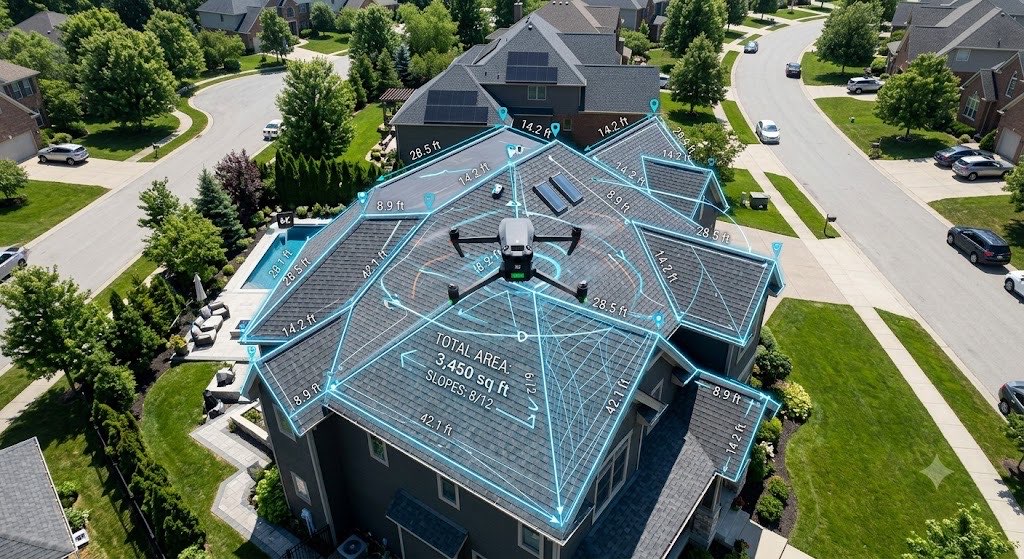
| Measurement | AI-native satellite + drone | Produces insurance-ready reports in 1–2 hours |
| Estimating | Integrated with measurement | Auto-prices full-envelope from measurement data |
| Contract execution | E-signature embedded in CRM | Contingency agreements signed on-tablet |
| Insurance claim submission | Carrier portal integration | Signed contingency forwarded within 24 hours |
| Supplement documentation | Drone + photo CRM attachments | Damage evidence for adjuster + supplement file |
| Production scheduling | CRM job board | Dispatches crews based on approval + materials |
| Customer communication | Automated SMS/email sequences | Keeps customers informed between sign and install |
Operations running all of these as integrated tooling — whether through a single platform like RoofManager or a well-wired stack of specialized tools — complete the 48-hour window with 50+ signed contracts and clean data flowing into week-two supplement and production work. Operations running paper, email, and three disconnected SaaS products hit the 8–12 signed contracts that traditional storm chasing produces, and miss the operational leverage that makes modern storm restoration profitable.
Territory and Canvassing Logistics
Two practical details that trip up operations new to storm deployments:
Territory mapping. Hail events are not uniformly distributed across a metro — they follow mile-wide swaths that match the storm's path. Free hail-mapping services (HailTrace, CoreLogic's HailMax, NOAA SPC reports) publish the affected radius within 24 hours of a major event. Canvassing teams should deploy only within the confirmed damage swath; knocking doors outside the swath produces low-conversion pitches and signals desperation to homeowners who compare notes.
Permit tracking. In high-volume markets (Texas, Oklahoma, Minnesota, Colorado), public permit records for active roof replacements are often pulled by competitors to identify post-storm activity. Operations should assume permits will be visible and plan accordingly; some markets use an LLC-specific filing shell for this reason. More importantly, permits often lag the canvassing window by weeks, so relying on permits as a lead-source beats only the slowest competitors.
Registration requirements. Minnesota, Texas, and a growing list of states require storm-restoration contractors to register, disclose the contingency agreement, and provide a specific cancellation notice period. Non-compliance voids contracts and exposes the operation to state action. Verify state-specific requirements before deploying in any new market.
Frequently Asked Questions
How do you get roofing leads after a storm?
The highest-ROI storm-lead sources in 2026 are: instant estimator capture of inbound calls (handles the 300–500% surge that voicemail misses), geographic-targeted digital ads triggered by storm events, door-to-door canvassing within the confirmed hail swath, and referrals from existing customers in the affected area. Paid lead-list purchases (Angi, HomeAdvisor, Modernize) deliver high-cost, low-quality leads and are rarely worth running during active deployments.
What is the "full envelope" in storm claims?
The full envelope refers to the complete exterior of the building covered by a single storm event — shingles, underlayment, ridge cap, hip and ridge vents, gutters, downspouts, siding, soffit, fascia, window screens, HVAC fin protection, and sometimes fencing and outdoor structures. A full-envelope contract captures all damaged components in one claim, which typically represents 30–60% more revenue per roof than a shingle-only estimate.
How fast do you need to respond to a storm damage lead?
How do you measure multiple roofs quickly?
Using AI-native satellite measurement platforms that produce insurance-ready reports in 1–2 hours from an address. The sales rep arrives at the site visit with the measurement already done and walks only damage documentation and contract execution. Manual measurement (tape + pitch gauge + sketch) caps throughput at 6–10 inspections per rep per day; automated measurement raises it to 15–20.
What percentage of roofing calls involve insurance?
During active storm deployments, 80–95% of new leads are insurance-related. In baseline (non-storm) periods, insurance calls run 15–30% of total lead volume, concentrated in markets with seasonal hail or tropical weather risk.
How do I qualify storm damage leads efficiently?
Three questions qualify 95% of inbound storm leads: (1) What is the property address? (triggers instant satellite measurement and damage-area confirmation), (2) Have you filed a claim yet? (determines claim stage and urgency), (3) Have you signed with another contractor? (determines competitive pressure and pace). Modern instant estimators ask these conversationally within the first 1–2 hours of the call.
What is a contingency agreement in roofing?
A contingency agreement is a contract between the homeowner and the roofing contractor stipulating that the contractor will perform the work if the homeowner's insurance claim is approved. The homeowner has no financial obligation if the claim is denied. It is the standard instrument of the first-48-hour storm restoration workflow and allows the contractor to commit resources (measurement, estimating, adjuster meeting) before the claim is underwritten. Legal specifics vary by state and province.
How much does a missed storm call cost a roofer?
Missed storm calls cost the operation the entire expected contract value of the missed lead — typically $12,000–$45,000 per lead for storm-restoration work, weighted by the operation's historical close rate on answered calls (usually 30–50% on storm leads). Operations with no way to capture inbound enquiries out of hours during a major deployment routinely lose $250,000–$1,000,000 in accessible revenue during the first 48 hours of a storm.
RoofManager runs the full 50-in-48 tech stack as a single integrated platform — satellite measurement, an Instant Estimator on your own site, CRM, e-signature, and insurance-ready reporting in one workflow. Start a free trial or book a storm-deployment onboarding call to map the play to your specific territory and crew capacity.