Roofing Proposal Software That Prices Itself: Turn Roof Reports Into Ready-to-Send Proposals
Reviewed by roofing measurement engineers · References NBC 2020, IRC 2021, FBC 8th Ed. · Roof Manager is the roof measurement & CRM platform trusted by 5,000+ contractors across the US & Canada · Editorial policy.
TL;DR
Set up your pricing once — line by line or per square by pitch — then turn any roof measurement report into a ready-to-send roofing proposal in one click.
It's 9:30 on a Tuesday night. You've been up since six, you ran crews all day, and you still have four proposals to write before tomorrow. So you open the spreadsheet, dig up the measurements, re-type the same twenty line items you typed last week, double-check the math, and hope you didn't fat-finger a number that costs you $2,000 — or the job.
For most roofing contractors, building proposals is the bottleneck between "got the lead" and "got the job." And it's an expensive bottleneck: industry sales research has long shown that 35–50% of sales go to the vendor that responds first. Every night a homeowner spends waiting on your quote is a night a competitor can beat you to their kitchen table.
The fix isn't working later. It's setting up your pricing once — and letting your roofing proposal software do the rest on every quote after that.
In this guide, we'll break down how pre-set pricing templates work, why price-per-square-by-pitch pricing protects your margins, and how Roof Manager turns a roof measurement report into a finished proposal with your exact price already sitting on it.
What Is Roofing Proposal Software?
Roofing proposal software is a tool that lets roofing companies create professional, branded quotes for roof replacements and repairs — automatically pulling in roof measurements, pricing, and line items instead of building every proposal by hand. The best roofing proposal software connects directly to your roof measurement reports and your CRM, so a proposal that used to take an hour takes about a minute.
That last part is the piece most contractors are missing. Plenty of tools will give you a pretty quote template. Very few will price the job for you using your own rates and the actual measured roof. That's the difference between a document builder and a proposal builder.
The Real Cost of Building Roofing Proposals by Hand
Before we get into how automated roofing proposals work, it's worth being honest about what manual quoting actually costs a roofing business:
- Your evenings. A detailed roofing estimate built by hand takes 45–90 minutes once you've measured, priced, formatted, and proofread it. Four quotes a night is a part-time job on top of your full-time job.
- Math errors. A transposed digit, a forgotten waste factor, or a wrong pitch multiplier doesn't just look bad — it either costs you the job (priced too high) or costs you the margin (priced too low). You often don't find out which until the job is done. The hidden cost of manual measurements compounds at every step.
- Inconsistent pricing. If two salespeople quote the same roof and come back with numbers $3,000 apart, you don't have a pricing strategy — you have a pricing lottery. Homeowners talk to their neighbours, and inconsistency erodes trust.
- Slow turnaround. The average homeowner collects three or more quotes. The first professional, detailed proposal they receive sets the anchor that every other bid gets compared against. If your quote shows up four days later, you're negotiating against a decision that's already half-made.
Manual proposals don't just take time. They quietly leak jobs and margin, week after week.
Pre-Set Pricing Templates: Build Your Price List Once, Use It on Every Proposal
Here's the core idea behind Roof Manager's proposal builder: you should never have to type your pricing twice.
Instead of starting every quote from a blank page, you set up a pre-set proposal template with your pricing built in. From then on, every new proposal starts pre-loaded with your numbers. There are two ways to set it up, depending on how your company prices jobs.
Option 1: Line-Item Pricing Templates
If you price jobs line by line, you build your template once with every item you normally quote:
- Tear-off and disposal
- Underlayment and ice & water shield
- Shingles (by product line, if you offer good/better/best)
- Ridge cap, starter, and hip & ridge
- Flashing, drip edge, and valleys
- Vents, pipe boots, and accessories
- Labour
Set your unit prices once, and every proposal you create afterward opens with your complete, correctly priced line-item list already in place. Adjust quantities for the job in front of you, remove what doesn't apply, and you're done. No re-typing, no copy-paste from an old quote, no "wait, what do we charge for ice & water again?"
Line-item templates are ideal for companies that want homeowners to see exactly what they're paying for — a format that also makes insurance and adjuster conversations dramatically easier.
Option 2: Price Per Square by Pitch
Many residential roofers price the simpler way: a set price per square (one roofing square = 100 square feet), with the rate climbing as the roof gets steeper. Steeper roof pitch means more actual surface area, slower production, more safety equipment, and more risk — so a 10/12 roof should never be priced like a 4/12 walkable.
With Roof Manager, you set up your price per square for every pitch one time. For example (plug in your own numbers):
| Roof pitch | Example rate per square |
|---|---|
| 3/12 – 6/12 (walkable) | $450 |
| 7/12 – 9/12 (steep) | $525 |
| 10/12 and up (very steep) | $600 |
Once your pitch-based rates are saved, you never calculate a total again. The software knows the pitch, knows the area, and knows your rate — so it does the multiplication for you on every single proposal.
From Roof Report to Finished Proposal in One Click
This is where the proposal builder stops being a convenience and starts being a competitive weapon, because it's connected to your roof measurement reports.
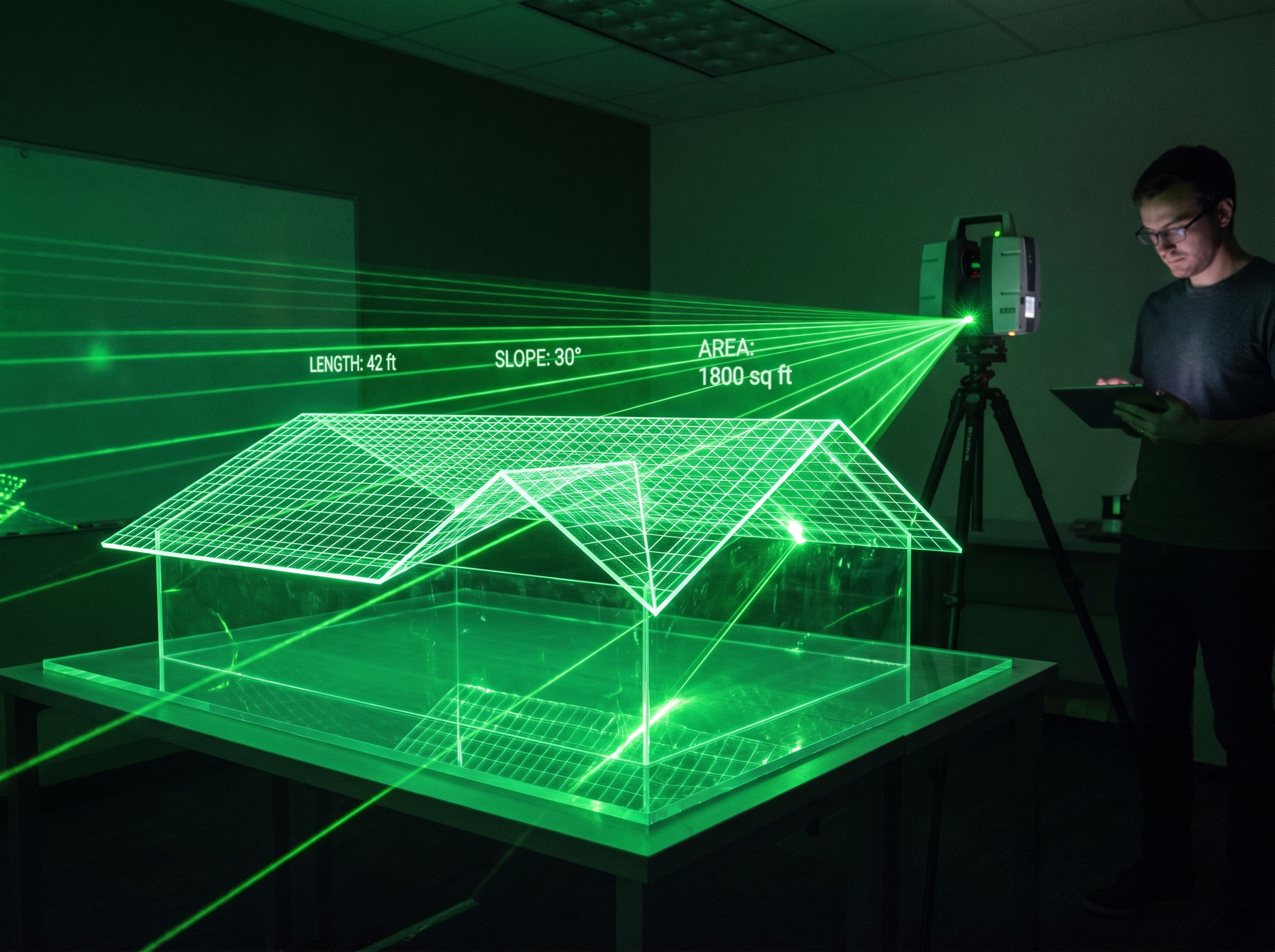
The measured, pitch-adjusted model that feeds your proposal — see a real report →

Here's the entire workflow inside Roof Manager:
- Order a roof measurement report for the property address. Reports are satellite-based, insurance-grade, 99% accurate, and delivered in under an hour — with pitch-adjusted areas, plus ridge, hip, valley, and eave lengths.
- Create a proposal and select the roof report it's for. That's the whole step. Pick the report.
- Your proposal is sitting there, ready — with your exact price on it. The measured area from the report is automatically multiplied by your pre-set price per square for that roof's pitch. If you use line-item templates instead, your full price list is pre-loaded and ready to fine-tune.
- Review, brand, and send — with e-signature and online payment links attached, so the homeowner can approve the job the moment they say yes.
Measure, click, send. A quote that used to eat an evening now happens before you've left the driveway — and it's more accurate than the hand-built version, because the area comes from an insurance-grade measurement report and the pricing comes from rates you set deliberately, not from memory at 10 p.m.
A Real-World Example
Say a lead comes in for a two-storey home in Calgary. You order the measurement report at 9:00 a.m. By 10:00 a.m., the report is back: 24.3 squares of pitch-adjusted area on an 8/12 roof, with all ridge, valley, and eave lengths included.
You open a new proposal and select that report. Your pre-set template already knows that your rate for 7/12–9/12 roofs is $525 per square, so the proposal is waiting for you with the price calculated: 24.3 squares × $525 = $12,757.50 — plus any line items you've templated on top, like skylight flashing or extra ice & water shield in the valleys.
You give it a thirty-second review, hit send, and the homeowner has a branded, signable, payable proposal before lunch — while the other two contractors they called are still promising to "swing by later this week." That's what speed to lead looks like in practice.
Why Pricing Per Square by Pitch Protects Your Margins
If you currently quote from a single blended rate, pitch-based pricing templates fix two silent profit leaks:
You stop undercharging steep roofs. A steep roof has more true surface area than its footprint suggests, takes longer to tear off and load, and requires harnesses, staging, and slower movement. If your flat rate was calibrated for walkable roofs, every steep roof you win is a job you're doing at a discount. With pitch-based templates, the correct rate applies automatically — no judgment call, no forgetting.
You stop overcharging easy roofs. The flip side matters just as much. On simple walkable roofs, a blended rate padded for "just in case" makes you quietly uncompetitive against sharper bidders. Pitch-accurate pricing lets you be aggressive where you can afford to be and protected where you need to be.
And because the rates live in the template — not in each salesperson's head — every quote your company sends is consistent. Same roof, same price, no matter who builds the proposal.
What Changes When Proposals Take Minutes Instead of Hours
Faster proposals aren't just a quality-of-life upgrade. They change the economics of your sales process:
- You quote same-day, every day. When a proposal takes a minute instead of an evening, "I'll get you a quote by the weekend" becomes "check your email — it's already there." That speed is the single cheapest competitive advantage in roofing sales.
- You send more quotes with the same team. More proposals out the door means more at-bats. If your close rate holds and your quote volume doubles, your revenue math changes without hiring anyone.
- Your follow-up actually happens. Inside Roof Manager's roofing CRM, every proposal feeds your pipeline — New, Quoted, Approved, Scheduled, Complete — with automated follow-up reminders at days 3, 7, and 14. The jobs that used to slip through the cracks after "let me think about it" stop slipping.
- You look like the most professional bid on the table. A clean, branded proposal with precise measurements and clear pricing signals that your crew will run the job the same way.
4 Proposal Mistakes That Cost Roofing Companies Jobs
Even contractors with great workmanship lose winnable jobs at the proposal stage. These are the four mistakes we see most often — and how pre-set templates quietly eliminate every one of them:
1. Quoting from the footprint instead of the true roof area. A home's footprint understates the real surface of a pitched roof, sometimes badly. Quote off the footprint and you either eat the shortfall in materials and labour or go back to the homeowner asking for more money — the fastest way to lose trust mid-job. Pitch-adjusted measurement reports remove the guesswork before the proposal is ever created.
2. Forgetting line items under time pressure. Drip edge here, pipe boots there — small items forgotten on a late-night quote add up to real money across a season. A template that always opens with your complete price list means nothing gets left off because you were tired.
3. Sending a lump-sum number with no story. "$14,500" on its own invites the homeowner to compare on price alone. A structured proposal — scope, materials, measured area, warranty, timeline — reframes the conversation around value and makes your bid the one the others get measured against.
4. Quoting once and never following up. Most homeowners don't buy the day the quote arrives. Without a system, "I'll circle back next week" turns into never. Because Roof Manager proposals live inside the CRM, follow-ups at days 3, 7, and 14 are automatic — the deal keeps moving even when you're on a roof.
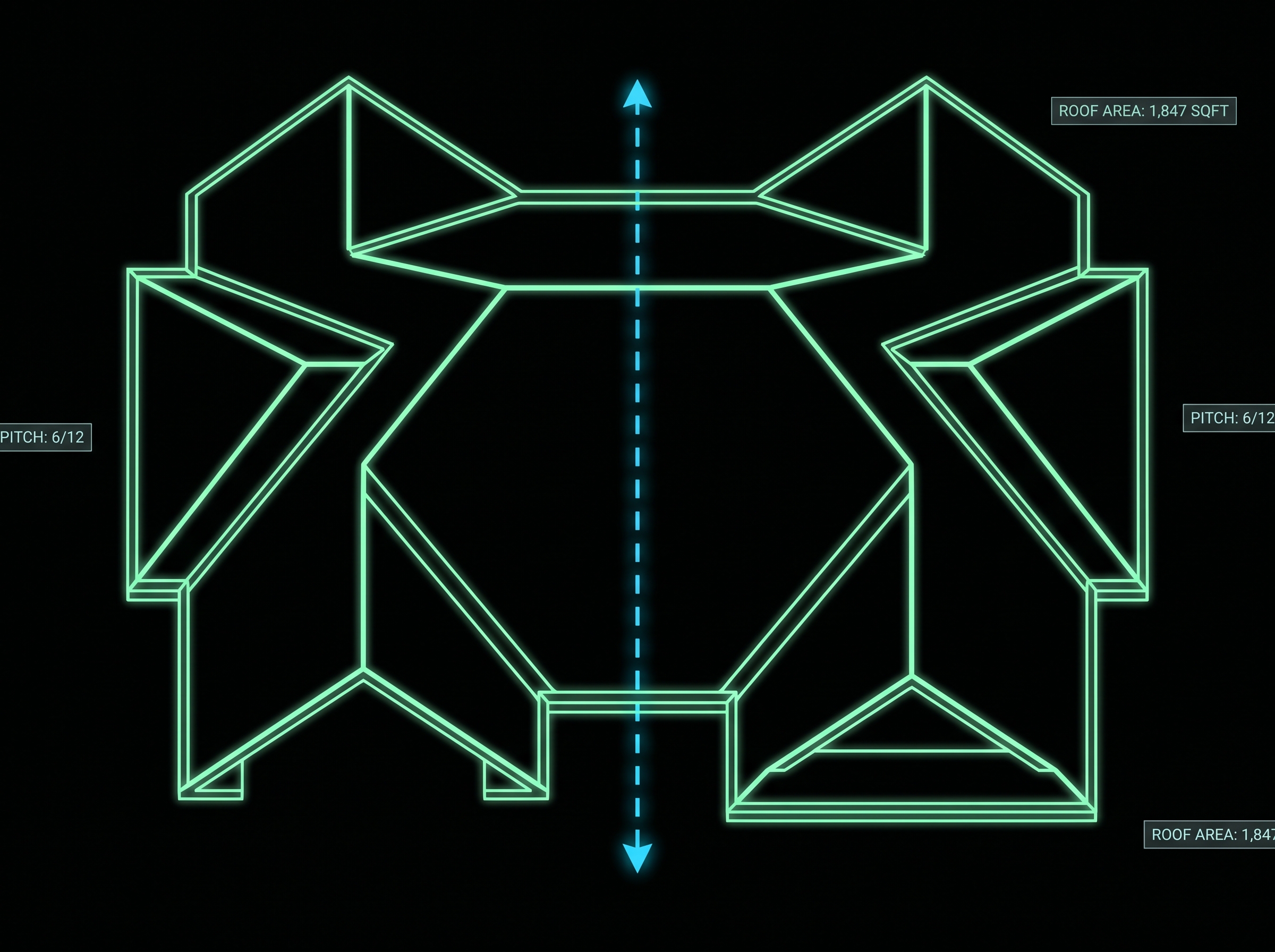
Every edge measured and labeled — the numbers your proposal is built on →
How to Set Up Your Proposal Template in Roof Manager
Getting the system in place takes one sitting:
- Pick your pricing model. Line-item pricing, price per square by pitch, or line items on top of a per-square base.
- Enter your rates once. Build your line-item price list, or set your price per square for each pitch bracket you work on.
- Order a measurement report for your next lead's address — it's back in under an hour.
- Create the proposal and select that roof report. Your price populates instantly from the measured, pitch-adjusted area and your pre-set rates.
- Send it and track it. E-signature, payment link, and automated follow-ups take it from there.
Set aside 30 minutes to load your pricing this week, and every proposal you send for the rest of the year is already built.
Frequently Asked Questions
What is a roofing square?
A roofing square is 100 square feet of roof surface area. Roofers price and order materials in squares — so a 2,400-square-foot roof is 24 squares. Measurement reports from Roof Manager report pitch-adjusted area, so your square count reflects the true surface being roofed, not just the home's footprint.
How does roof pitch affect the price of a roofing job?
Steeper roofs cost more per square because they have more actual surface area, take longer to work on, and require additional safety equipment. Most contractors price in pitch brackets — for example, walkable (up to 6/12), steep (7/12–9/12), and very steep (10/12+) — with the per-square rate increasing at each bracket.
What should a roofing proposal include?
A complete roofing proposal should include the scope of work, materials and product lines, measured roof area, itemized or total pricing, warranty details, an estimated timeline, payment terms, and a signature line. Proposals generated from a measurement report add credibility because the homeowner can see the numbers come from an insurance-grade report, not a guess.
How fast should a roofing contractor send a quote?
Same day is the target, and within 24 hours at the outside. Research consistently shows a large share of jobs go to the first contractor to deliver a professional quote. With pre-set pricing templates and one-hour measurement reports, same-day quoting becomes your default rather than your best case.
Can proposal software pull prices from a roof measurement report?
Yes — that's exactly how Roof Manager's proposal builder works. You pre-set your pricing (line by line, or per square for each pitch), and when you select a roof report, the proposal auto-fills using the report's measured, pitch-adjusted area and your saved rates. The result is a ready-to-send proposal with your exact price, with no manual calculation.
Do I need separate estimating software and proposal software?
Not if they're built together. When your measurement reports, pricing templates, proposals, e-signatures, and CRM pipeline live in one platform, data flows automatically from measurement to quote to signed contract. Separate tools mean re-entering the same numbers at every step — which is exactly where errors and delays creep in.
How much does roofing proposal software cost?
Roof Manager's CRM and proposal builder are free to use, with satellite measurement reports at $10 CAD each — and your first two reports are free. A monthly plan at $199 covers up to 40 reports. Compared to platforms charging hundreds per month plus expensive per-report fees, pay-as-you-go pricing keeps proposal automation within reach of small and mid-size roofing companies.
Stop Rebuilding the Same Proposal Every Night
Your pricing doesn't change from quote to quote — so why are you re-typing it from scratch every time? Set it up once in Roof Manager, and from then on every proposal is one click away: select the roof report, and your quote is sitting there with your exact price on it.
Roof Manager is the all-in-one roofing CRM built for roofing companies across Canada and the U.S. — satellite roof measurement reports in under an hour, a proposal builder with pre-set pricing templates, e-signatures, payment links, and automated follow-up, all in one place.
Start free today: you get unlimited CRM access and your first two roof measurement reports on us — see pricing or look at a real measurement report first. Load your pricing once, and see how it feels to send tomorrow's quotes before dinner.
Read next: How to manage roofing leads and customers in Roof Manager — the step-by-step walkthrough of the Leads and Customers modules, from first call to collected payment.
Read next: How to build a roofing proposal in under 5 minutes — attach the roof report, let it price itself from your per-pitch template, and send it for online signature.